

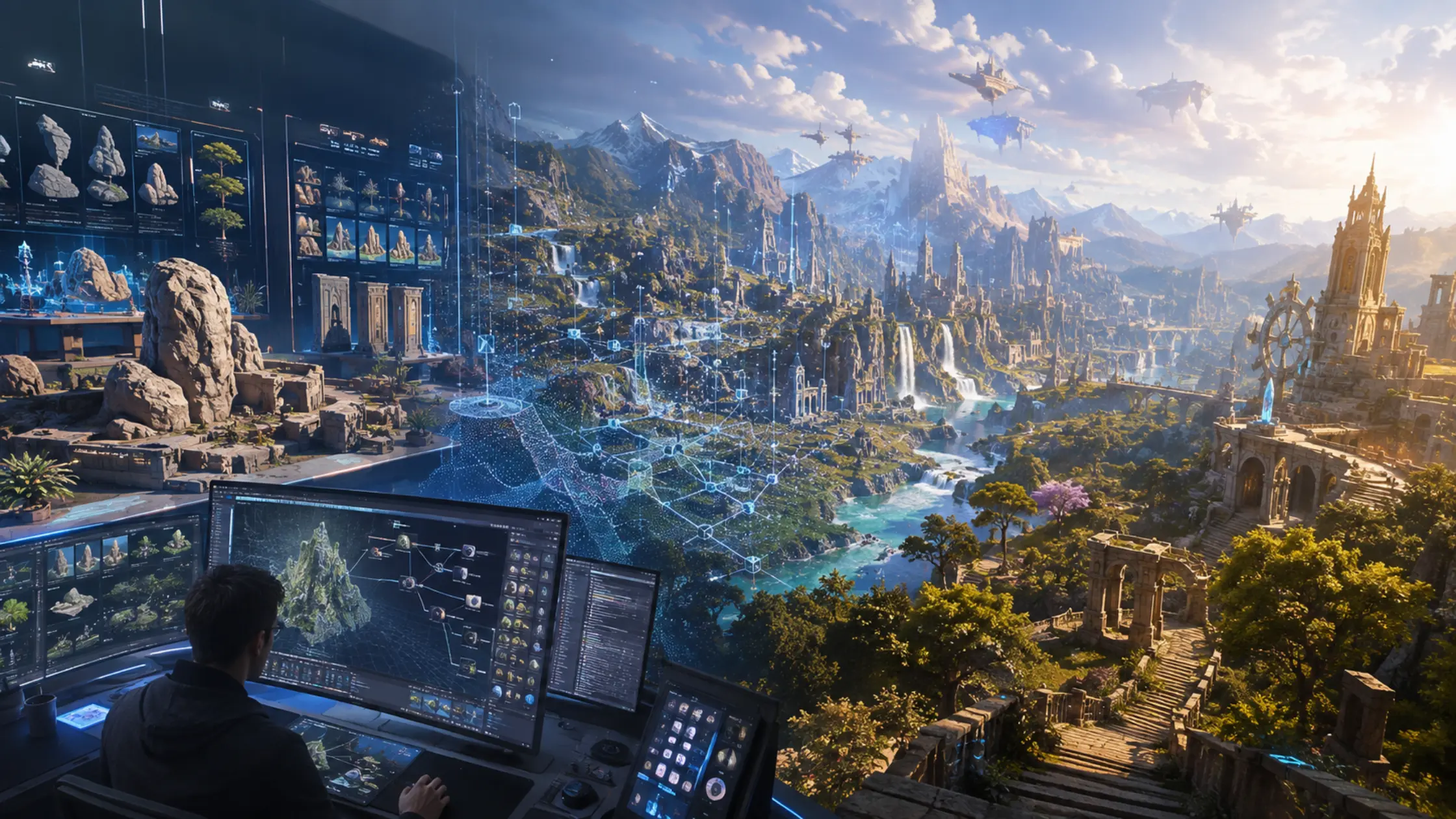
Procedural art tools have moved from experimental to production-standard. The bottleneck is now in knowing how to integrate them into pipelines that were built for a different model of asset creation.
Procedural generation in game art has a long history of being announced as the future and then quietly relegated to a supporting role. The actual adoption curve has been slower than predictions because procedural workflows require a different kind of thinking from both artists and technical directors one that treats rules and systems as the creative output rather than individual assets.
That situation has changed significantly in the past three years. Houdini’s integration with game pipelines has matured. Substance Designer’s procedural material approach is now standard practice in most mid-to-large studios. Speed Tree and similar tools are production-standard for environmental vegetation. And Unreal Engine 5’s PCG framework has put a reasonably accessible procedural content generation system in the hands of teams that never would have built their own.
The productivity case for procedural workflows in specific applications is genuinely compelling. Environments that use procedural rock, terrain, and foliage placement can generate draft-quality levels in hours that would previously have taken weeks of manual placement. Material variations that would require individual texture authoring can be generated from a single parameterized material graph. This isn’t hypothetical studios using these approaches are measuring the time savings and they’re significant.
Procedural tools don’t make art directors less important. They make art direction decisions more consequential, because those decisions now apply to everything the system generates.
What’s harder to talk about honestly is the quality ceiling of current procedural generation in game art. Procedural systems are excellent at generating plausible variation within a defined range. They’re poor at generating the specific, considered choices that make environments feel designed rather than generated. Players may not consciously identify the difference, but they experience it as an emotional distinction: a space that feels like someone thought about it versus a space that feels like it was produced.
The most effective procedural workflows in production right now are hybrid approaches. A procedural system generates the broad structure, distribution, and variation; artists then curate, override, and add the specific moments of interest the composition that makes a vista worth stopping for, the detail that tells an environmental story, the cluster of objects that rewards exploration. This requires pipelines that make curation as efficient as generation, which is a workflow design problem many studios haven’t fully solved.
The skills gap is also real. Environment artists trained in traditional manual workflows need genuine investment to become effective with procedural tools not just a tutorial, but enough supervised production time to build intuition for where procedural approaches solve problems versus where they create new ones. Studios that treat procedural tooling adoption as a training event rather than a sustained change management process consistently see slower adoption and more frustration than those that treat it as a long-term capability investment.
The tools are ready. The question is whether pipelines and teams are structured to use them effectively rather than using them awkwardly in parallel with the workflows they were meant to replace.