
Most outsourcing partnerships fail not because the talent is wrong, but because the briefs, feedback loops, and integration processes are broken
Outsourcing game art is one of the industry’s most misunderstood production strategies. It’s often treated as either a silver bullet cheap capacity, infinite scalability or a necessary evil to be minimized. Neither framing is accurate, and both lead to predictable failure patterns that waste enormous amounts of time and money.
The honest version of how outsourcing works in game production looks like this: it can be genuinely effective for well-defined, technically stable work where the art direction is locked, the asset specifications are clear, and there’s a functioning review process in place. It tends to fail when studios treat it as a solution to problems that are actually organizational or directional rather than capacity problems.
The most common failure mode is outsourcing art in a production where the style isn’t yet fully defined. A studio in pre-production, still evolving its visual identity, commissions hundreds of environment assets from external partners. The partners produce competent work according to the brief they were given. Six months later, the art direction has evolved. Every piece needs to be reworked or discarded. The studio blames the outsource partner; the outsource partner did exactly what they were asked to do. The actual problem was a process failure, not a quality failure.
The studios that outsource well treat their external partners as production infrastructure, not as a way to avoid making creative decisions.
Good outsourcing relationships require three things that are more difficult than they sound. First: precise documentation. Asset specifications that leave room for interpretation will be interpreted differently by every artist who reads them. Style guides need to define not just what assets should look like but what they should not look like anti-examples are as valuable as positive references.
Second: a dedicated review pipeline with clear ownership. Outsourced assets that go into a general queue and get reviewed ‘when someone has time’ consistently accumulate problems. Dedicated review cycles with a single point of accountability on both sides prevent small misalignments from compounding into large ones.
Third: realistic lead time expectations. Studios that treat outsource partners as an emergency overflow capacity sending large batches with short turnarounds whenever internal production falls behind consistently get worse results than studios that plan outsource workloads in advance and treat external partners as part of the production schedule rather than outside of it.
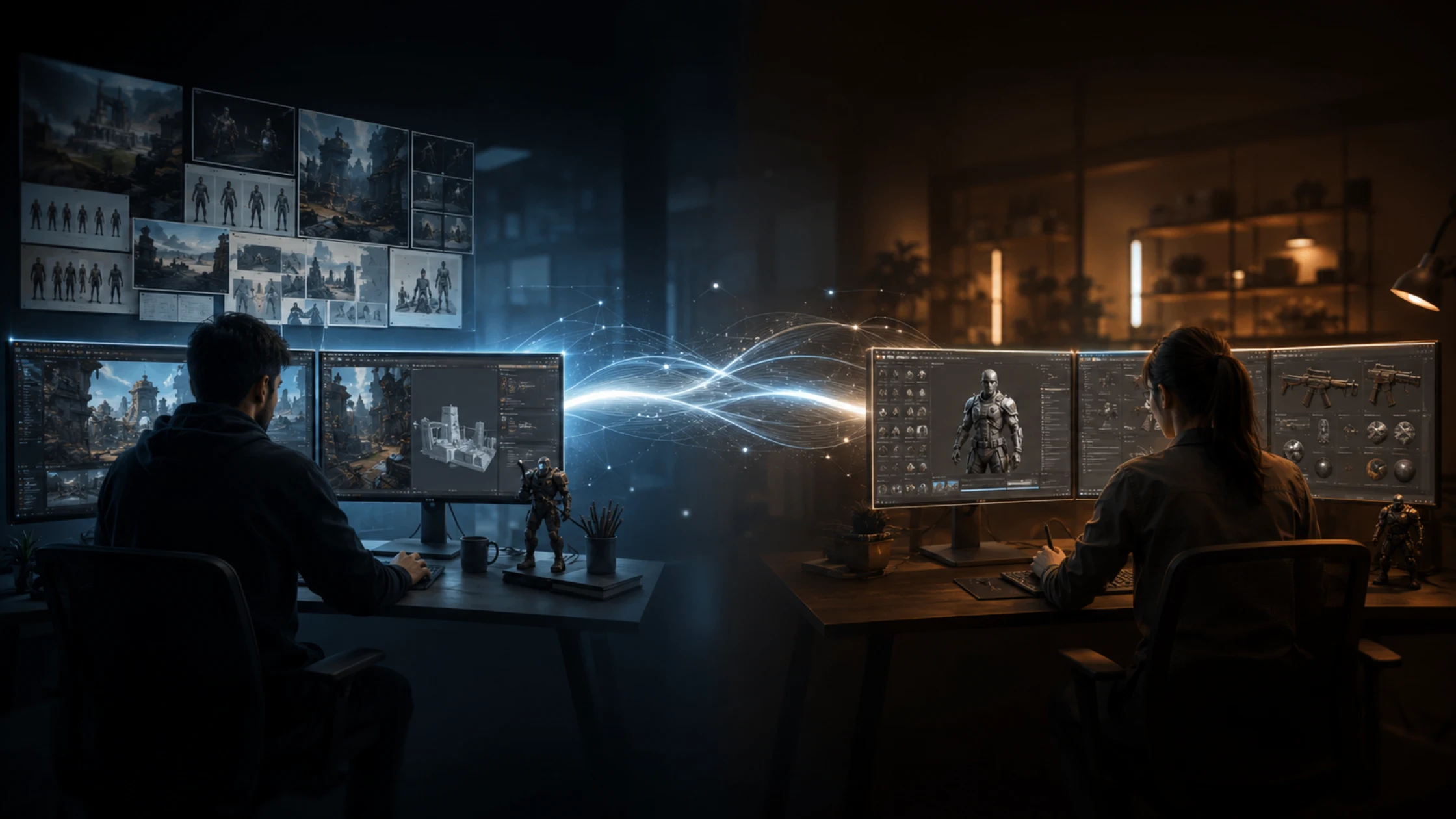
The in-house vs. outsource question is also more nuanced than the usual framing suggests. In-house teams hold institutional knowledge, iterate faster on ambiguous briefs, and absorb misdirection with less systemic damage. Outsource partners scale efficiently, bring specialized expertise, and can turn high-volume, well-specified work faster than internal teams stretched thin. The strongest production pipelines use both, with clear thinking about which work belongs where.
There’s also a quality ceiling conversation worth having. The best outsource partners produce excellent work. They also need clear direction to do it. Studios that consistently receive mediocre outsourced art often have an internal art direction problem they’re externalizing. Fixing the direction fixes the output, regardless of where the work is being done.
Outsourcing game art is a discipline, not a transaction. Studios that treat it as a discipline with processes, documentation, and genuine partnership get results. Studios that treat it as a way to buy time on an unresolved production problem tend to buy expensive time on an unresolved production problem.