

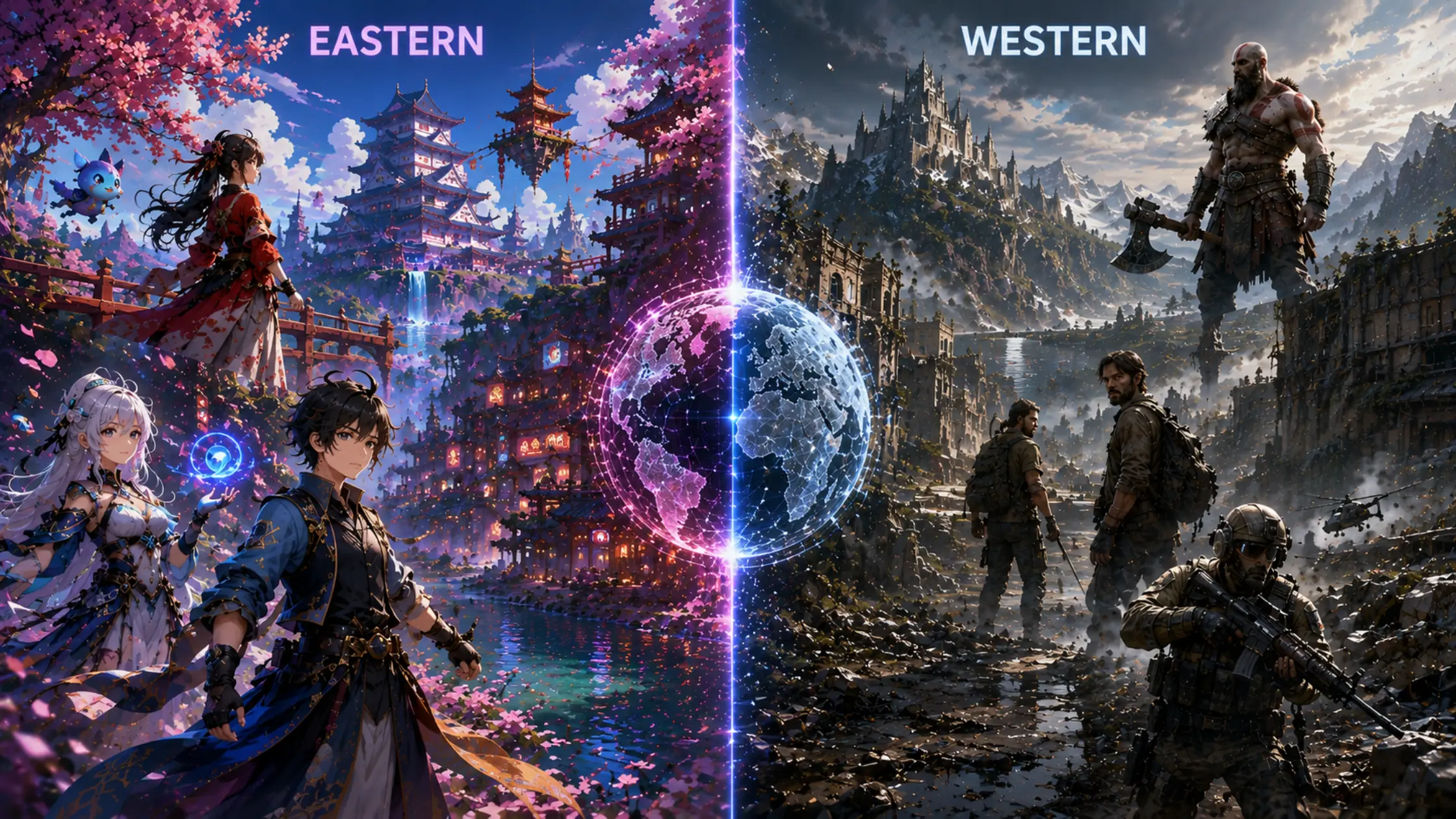
The East-West distinction in game art preferences is real but it’s also more nuanced, more shifting, and more commercially significant than the usual oversimplifications suggest.
The conventional wisdom on regional game art preferences runs roughly like this: Western markets prefer realistic, gritty, dark-toned aesthetics think The Last of Us, God of War, Call of Duty. Eastern markets, particularly Japan and parts of Southeast Asia, prefer stylized characters, exaggerated proportions, vibrant palettes, and the visual language descended from manga and anime. Therefore, studios building for one market should make art that looks different from studios building for the other.
This framework is directionally accurate and practically insufficient. Following it uncritically produces work that misses real opportunities and ignores the ways both markets have evolved in the past decade.
The more interesting observation is how significantly the visual preferences in both markets have converged on certain styles. Genshin Impact developed by Chinese studio miHoYo is among the highest-grossing games globally, including in Western markets, with an aesthetic firmly rooted in Japanese anime visual language. Final Fantasy XVI built a deliberately Western dark-fantasy tone. Black Myth: Wukong used photorealistic rendering in service of East Asian mythology. These aren’t niche crossovers. They’re large-scale commercial successes that complicate the idea that markets have rigid aesthetic requirements.
The real East-West divide in game aesthetics is less about style preference and more about how each tradition thinks about character design and world logic.
What persists as a genuine difference isn’t palette or rendering style it’s the approach to characters and their relationship to the game world. Japanese design traditions tend to produce characters as the primary expressive unit of a game: high investment in distinctive silhouettes, readable facial expression design, elaborate costume logic that communicates personality before a word of dialogue. Western design traditions often invest more in world believability, treating characters as elements within an environment rather than as autonomous expressive objects. These are different design philosophies, and they produce different experiences that players have genuine preferences for but those preferences aren’t determined by geography as cleanly as the conventional wisdom suggests.
Mobile markets add another layer of complexity. Southeast Asia, particularly markets like Indonesia, Vietnam, and the Philippines, has developed a strong preference for hyper-casual and mid-core games that draw from both Eastern character design and Western color simplicity. Studios entering these markets with content designed for Japanese or Western console audiences frequently miss the specific visual register that resonates locally.
The practical implication for studios doing international work is that regional art direction requires genuine market research rather than the application of demographic proxies. What resonates in South Korea is not identical to what resonates in Japan, despite both being ‘Asian markets.’ What works in the UK is not identical to what works in the United States, despite both being ‘Western markets.’ The details matter, and the studios that do the research to understand them produce more effective work than those that apply broad-brush regional assumptions.