
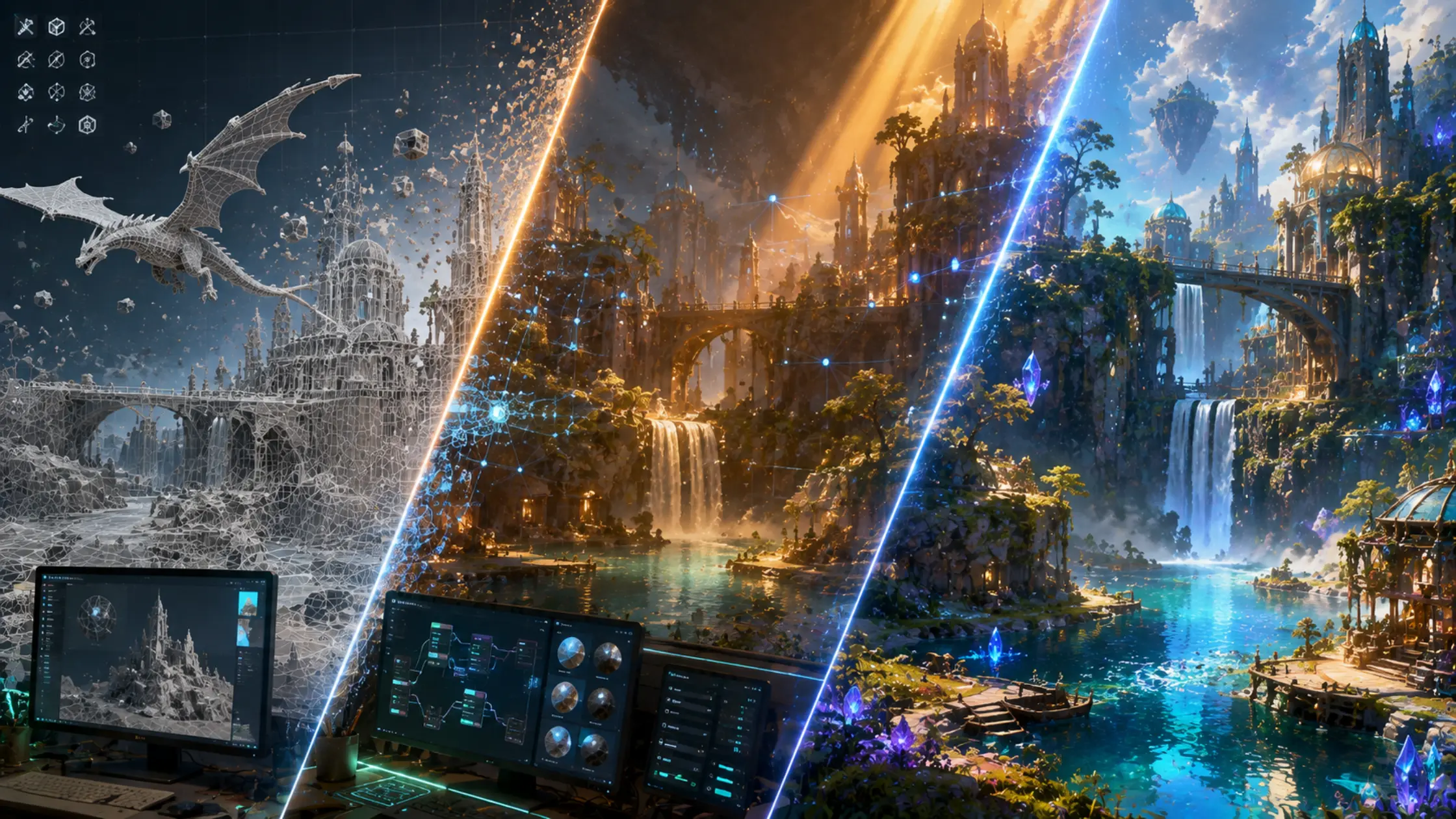
When Epic introduced Lumen and Nanite as central features of Unreal Engine 5, the industry conversation focused almost entirely on visual output the quality of Lumen’s global illumination, the detail levels Nanite enabled, the comparison screenshots. This is understandable. The outputs are impressive. But the more consequential question for working game art teams is what these technologies change about how work gets made, not just what the results look like.
Nanite’s impact on environment art pipelines is genuinely significant and not always described accurately. The headline you can now use film-quality geometry directly in games is true but incomplete.
What’s changed isn’t just polygon budgets; it’s the relationship between high-res and game-res assets in the pipeline. Photogrammetry workflows that previously required laborious retopology and baking steps now move faster because Nanite handles the LOD management that artists used to do by hand.
For studios doing environment work, this is a real productivity gain in specific workflows. It doesn’t eliminate the need for strong art direction, asset organization, or material design areas where the workload is unchanged or increased. But it does compress one historically expensive part of the pipeline, and that compression is meaningful at production scale.
Lumen changed the question from ‘how do we fake good lighting?’ to ‘how do we design with real light?’ That sounds like a small shift. It’s actually a fundamental change in how environment artists need to think.
Lumen’s implications are subtler and, in some respects, more demanding for art teams. Dynamic global illumination means that the lighting quality of any environment is now significantly determined by the environment’s material design specifically, how assets respond to and reflect light. Studios whose environment artists were primarily focused on diffuse color and normal map detail need to develop stronger material authoring skills to take full advantage. Lumen rewards the kind of thoughtful material design that artists have always been encouraged toward; it just makes the gap between thoughtful and careless more visible.
Path tracing, which several recent console and PC titles have shipped with as a high-quality mode, is at a different point in its adoption curve more relevant to studios targeting high-end PC players than to the broad game market. But its presence in shipped products is moving the visual reference point for players faster than previous rendering generation transitions, and studios building content for current-gen platforms should be aware that player expectations are being reset by titles like Alan Wake 2 and Cyberpunk 2077’s RT Overdrive mode.
The toolchain implications of these technologies deserve a candid note. UE5’s most impressive features are impressive when they’re working correctly on hardware that can run them. Studios supporting a wide hardware target range still need to think carefully about how their content degrades on lower-spec configurations, which requires maintaining something resembling the old scalability thinking alongside the new capabilities.
The underlying trend these technologies represent is the continued shift of technical complexity from artists to engines. The work that engine teams are absorbing LOD management, global illumination, certain categories of texture baking represents hours of artist time per asset that can be redirected toward design decisions. That’s a positive development for art quality, provided the production process is structured to take advantage of it.