
AI tools are already reshaping game art production but not in the ways most people outside
of production are describing
The conversation about AI in game art tends to take place at two extremes. On one side: breathless coverage of a tool that will replace all concept artists. On the other: defensive dismissal from artists who’ve decided the technology is categorically beneath consideration. Neither position is useful, and neither reflects what’s actually happening in production.
Here’s what is happening: studios that are integrating AI tools thoughtfully are seeing real gains in specific, bounded parts of their pipeline. Studios that are trying to replace wholesale production stages with AI outputs are running into walls quality, consistency, legal, and cultural ones faster than they anticipated.
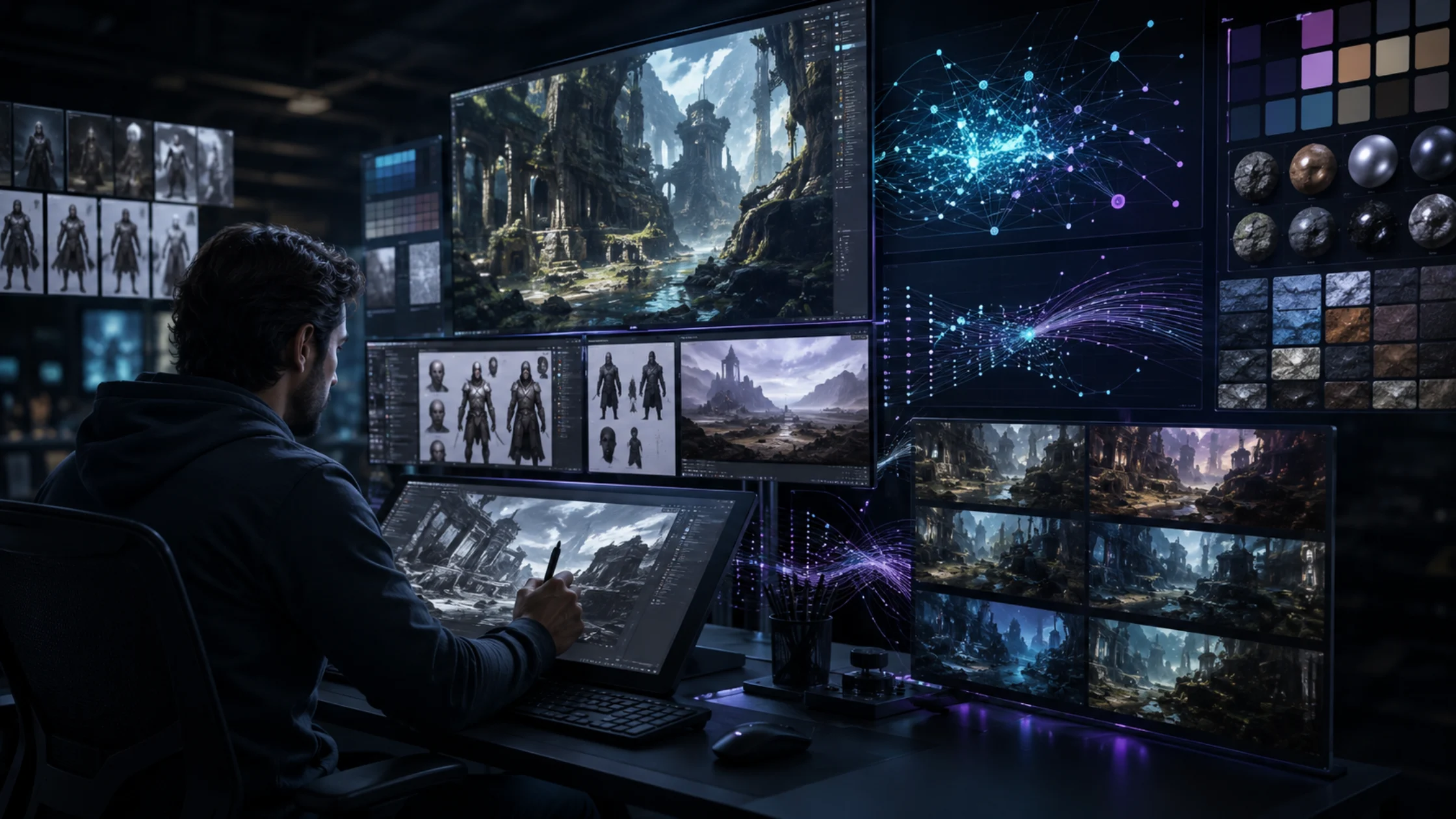
The categories where AI genuinely accelerates production right now are reference and ideation. Using a generation tool to rapidly explore color palette variations, broad composition directions, or costume silhouette options early in pre-production can compress a process that used to take days of back-and-forth into hours. The output isn’t final art. It’s thinking made visible, faster. Concept artists who understand this are using these tools to do more, not to be replaced by them.
The studios winning with AI are treating it as a thinking accelerator, not an asset factory. The distinction matters enormously.
Texture generation is another real win. Tools like Stable Diffusion fine-tuned on material libraries can produce usable starting points for environment surfaces rock, soil, worn concrete, rust that need significant human refinement but save meaningful hours compared to starting from scratch. Substance Designer’s AI-assisted features are advancing in similar directions with more production-safe tooling around them.
Where AI is consistently failing to deliver is in character art and any work requiring internal consistency across a production. Generating a compelling standalone character illustration is achievable. Generating that character in twenty different poses, with consistent features, in a style that matches a specific game’s other characters, integrated into a pipeline with version control and approval workflows that’s a different problem entirely, and the current tools aren’t close to solving it at production quality.
Environment concept art has similar limitations. AI tends to produce compelling but generic spaces it’s very good at ‘industrial corridor’ as a category, and very bad at ‘the specific industrial corridor that matches this game’s world logic and belongs in this narrative moment.’ Art direction specificity, which is the actual value in game environment design, is where AI still produces noise.
The legal and IP dimension is worth treating seriously rather than dismissing as a bureaucratic concern. No major publisher has yet fully resolved its position on AI-generated content in shipped products, and several have issued internal restrictions. Studios building pipelines around AI-generated assets for client work need explicit written clarity on what’s permissible, and that clarity doesn’t yet exist in industry-standard contracts.
What the hype misses most consistently is that game art production’s most expensive bottlenecks are rarely about raw asset generation speed. They’re about review cycles, iteration on feedback, consistency maintenance across a large team, and the coordination costs of complex pipelines. AI tools address none of these structural problems. A faster way to make the wrong asset is still a faster way to make the wrong asset.
Studios spending the most valuable time with AI right now are the ones who have analyzed their specific bottlenecks first, then asked whether any AI tool addresses them not the ones who adopted tools because the tools were available. The difference in outcomes between those two approaches is significant.