

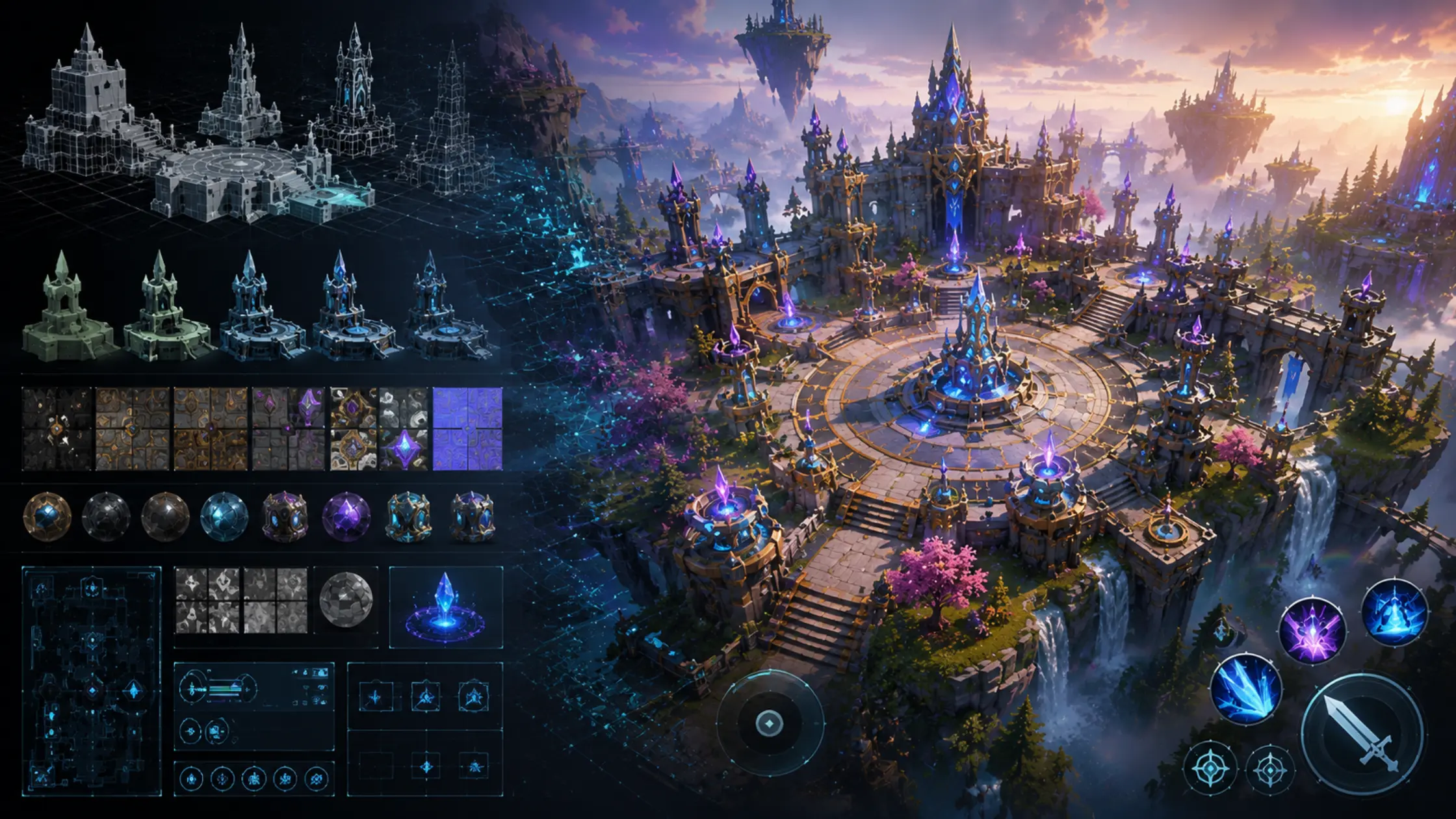
The constraints of mobile aren’t reasons to lower standards. They’re a different design problem and one that requires more craft, not less.
There’s a persistent condescension in the games industry toward mobile art. It shows up in the way studios describe their portfolio ‘we do console and mobile work’ with the comma carrying a kind of apology. It shows up in compensation structures, in the prestige hierarchy of projects, and in the design conversations where mobile work is framed as a simplified version of the ‘real’ thing.
This framing is wrong, and it’s costing studios that hold it because they’re solving the wrong problem when they approach mobile art production
Designing game art for mobile is not a constrained version of designing game art for console. It’s a different discipline with different success criteria, different technical realities, and, in several respects, harder design challenges. The canvas is smaller, the hardware budget is tighter, the interaction model is fundamentally different, and the context of play a bus, a lunch break, five minutes between meetings demands that visual communication work faster and with less of the player’s sustained attention than any console experience requires.
Designing for a small screen with a short attention window and ten milliseconds to earn engagement is harder than designing for a 4K display with a controller. Not easier. Harder.
Consider what Clash Royale or Pokemon GO actually accomplish visually. Every asset in Clash Royale reads clearly at sizes that would make the same character unrecognizable in a more detailed style. The silhouette language is so strong that the game communicates unit type, threat level, and faction affiliation at a glance, under thumb, mid-battle. That’s not a lesser achievement than a beautifully detailed RPG character. It’s a different achievement that demands its own mastery.
The technical constraints of mobile are real, but they’re also shifting. Current high-end mobile hardware runs Unreal Engine 5 features that were console-exclusive two years ago. The ceiling is rising quickly, and studios treating mobile as a lowest-common-denominator visual target are going to find themselves behind the quality curve faster than they expect.
The more persistent constraint isn’t hardware it’s UI density. Mobile screens present information in close proximity under thumbs, on screens held at varying distances, in variable lighting conditions. This is an environment where UI/UX design quality is more commercially important than raw art quality. A beautiful game with confusing UI will fail on mobile faster than a technically modest game with clear, responsive, well-considered UX design. This is one reason why mobile-first studios tend to develop stronger UX craft than their console counterparts the consequences of poor UX are immediate and measurable in retention data.
Studios that approach mobile work with the same philosophical rigor they’d apply to any other platform clear art direction, strong silhouette thinking, deliberately limited color palettes that read under compression, UX that respects the interaction model produce work that’s genuinely impressive. And in a market this large, producing genuinely impressive mobile art is a commercially significant capability, not a consolation prize.